Monday, August 17, 2015

Toothless Clamshell - Loading the Small & Medium Size Stones "version 2.0"

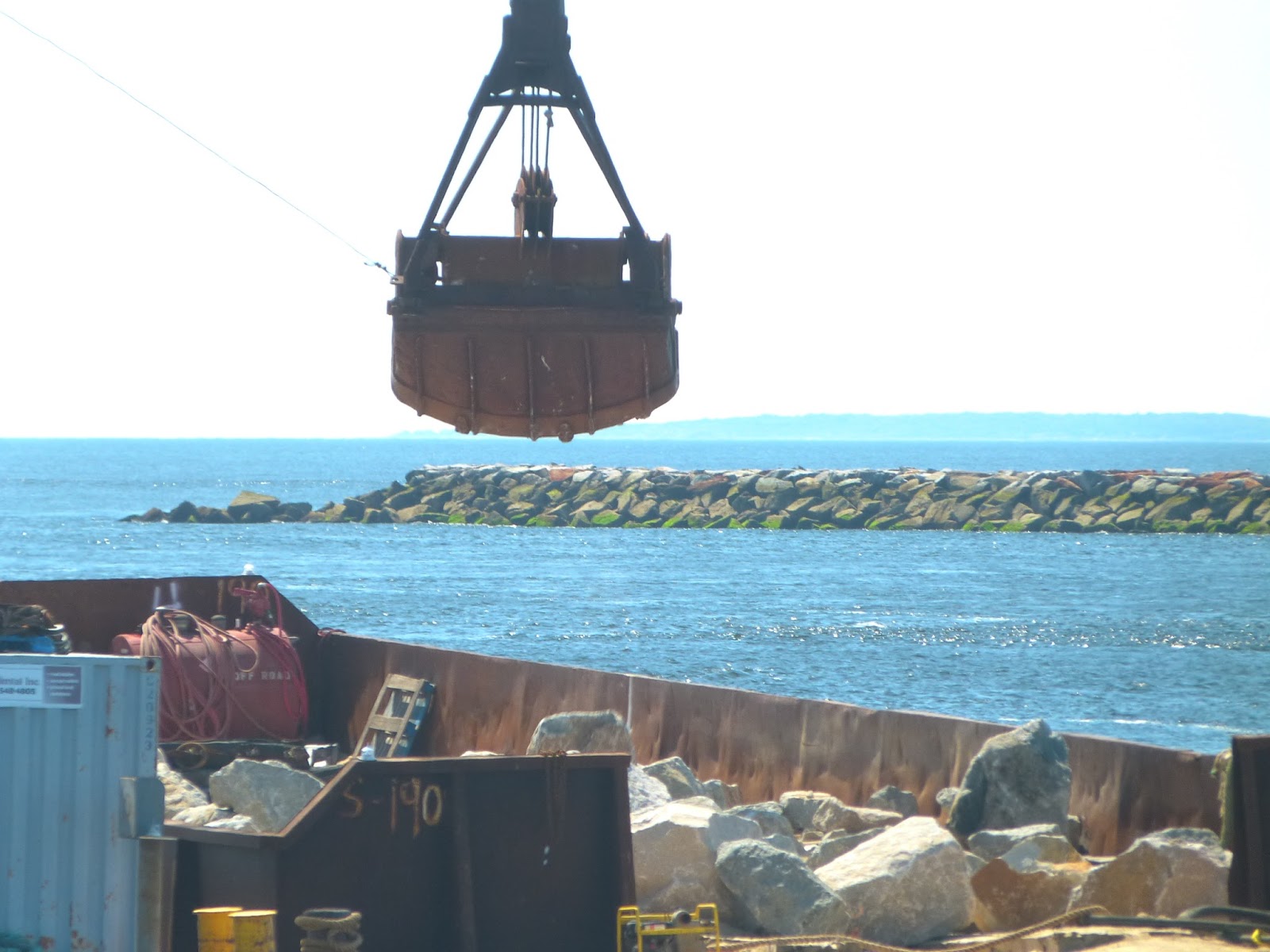
The stone buckets shown in the previous two posts simply couldn't keep up with the shear volume of small and medium size stones being brought in by the dump trucks. The crew needed to be able to move an entire scowl full of this stone out to the Salisbury jetty. The crane was equipped with a clamshell bucket for grabbing the stone. It was a great idea in theory but problematic in practice. The clamshell had a hard time grabbing more than one medium size stone at a time or a decent bucket full of the small stones. The problem seem to be with the shallow design of the bucket and the lack of teeth on it. The short term fix to this problem was to have the excavator load the clamshell. The video captures this process. It put the excavator operator's skills to the test. You will see him adjusting the position of the clamshell and also very carefully loading it. It was good short term solution. However, It was time consuming and took the excavator away from its other duties of moving the stones dumped by the trucks onto the pile where the crane could pick them up.

On my next visit to the construction site (about a week later), I found the toothless clamshell  unceremoniously beached on the sand in the construction staging area. The crew had come up with a new solution ... which I will discuss in the next post.

 
Video of the toothless clamshell and in action.


"bye-bye" excavator


Toothless clamshell managed to grab a single stone


Excavator filling the clamshell


A sequence of photos showing the clamshell dumping its load into the scowl.


This is what happens when you don't load the scowl evenly .. it tilts to one side.

Friday, August 14, 2015

Loading & Unloading the Stone Buckets

I had been wondering for a while how the construction crew unloaded the stone in the buckets onto jetty. I finally got a chance to video the process. Two to three stone buckets are loaded either onto the crane barge or into the stone scowl and brought out to the Salisbury jetty. Four steel cables are attached to the bucket, one at each corner. The bucket is lifted off the barge or scowl and set down on the jetty. The construction workers then remove two of the cables on one end of the bucket, the other two are left attached. The crane lifts up one end of the bucket dumping the stones onto the jetty. The bucket is then swung back to the scowl. The excavator moves into to rearrange the stones.

The video briefly recaps the whole process: It shows a dump truck delivering the small and medium size stones. The crane lifting the bucket from the beach staging area and swinging it over to the scowl. (I never got a chance to see the excavators loading the bucket). Finally the  crane dumping the bucket on the jetty. The process of dumping the stone on the jetty took some time. The video has been edited to show the highlights of the process.


Two stone buckets sitting in the scowl waiting to be take out to the jetty.


Dump truck delivering stone.

Wednesday, August 12, 2015

Lifting a Stone Bucket - Black & White Photos

The small and medium size stone being trucked in and piled up is being used to build up the core of the jetty. This smaller stone is then being covered by the large mutli-ton stone blocks. How are they getting this stone out to the Salisbury jetty? They have several large steel buckets on site which they fill with stone. Four cables are attached to the bucket and the crane lifts it off the beach onto the barge. In the next post I will have video showing how the buckets are dumped onto the jetty.

I find that black & white photography is very effective at conveying the industrial and mechanical feel to the site.

If you drop by the Salisbury Beach State Reservation to see the action (It is worth the trip to see this operation up close!), I have few tips on photographing. The lighting conditions have proven challenging to deal with. you have the sky which can range from a nice blue to hazy white to gray overcast. The ocean and Merrimack River tend to be on dark end of lighting range. Digital camera tend to struggle trying to balance these strong contrasts. A number of digital cameras have an adjustment for EV +/- which I made extensive use of to compensate for the lighting. Another detail to be aware of the lighting on the tractors and cranes. Depending on the angle of the sun, they can be either in  good lighting showing their coloration or in shadow. Shadow makes everything dark and you lose a lot of detail. This problem is evident with the barges in the last photo. The lighting conditions can shift dramatically simply by swing the camera around to a different angle.


The crane swings around with four steel cables.
 

The crew attaches one cable to each corner of the bucket.


The bucket lifted up just high enough to clear everything on the construction site.


The bucket is swung over to the  barge.


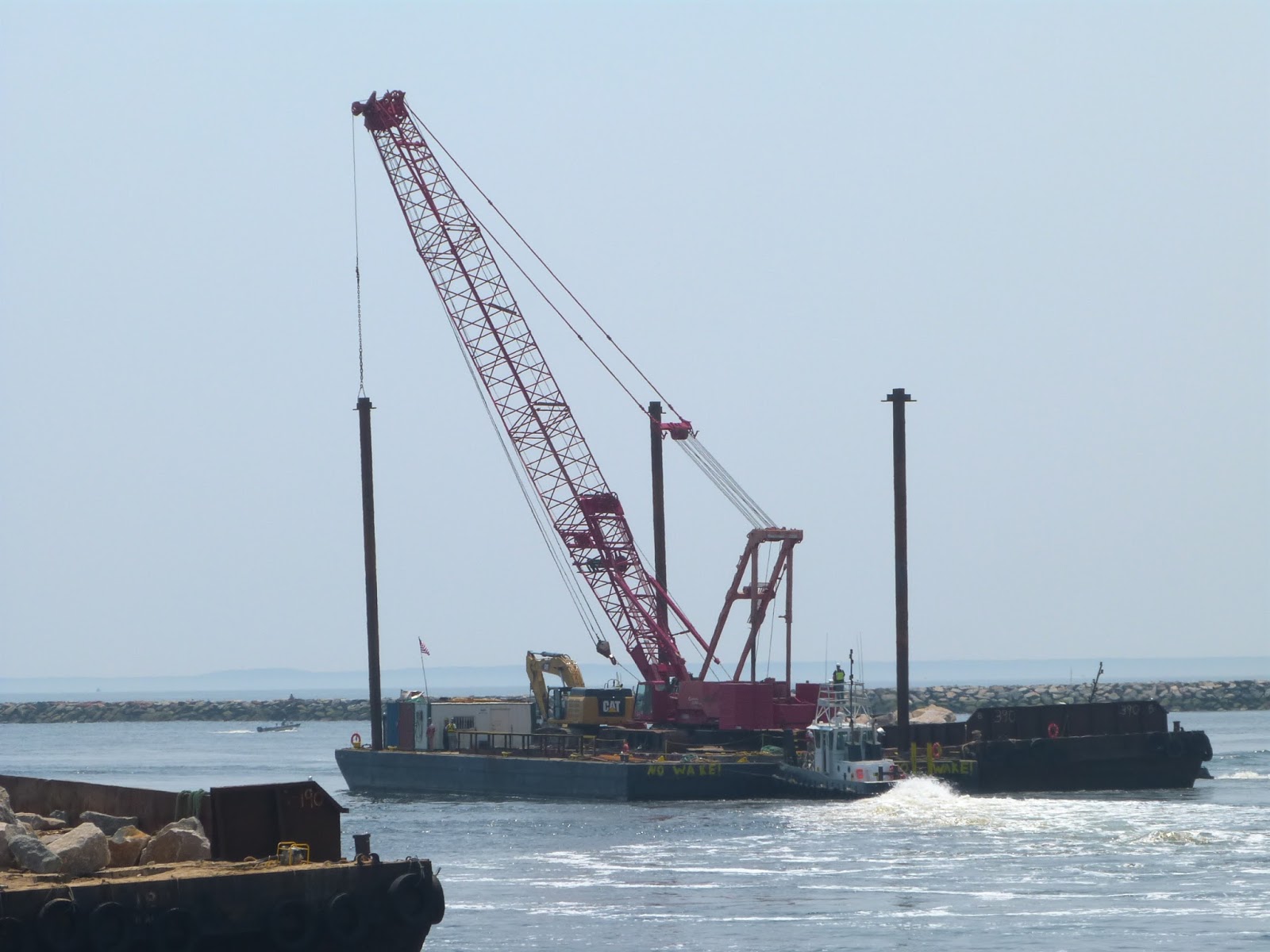
Overall view showing the crane barge, two stone scowls tied up to the barge on the right, and two tugboats the ferry the barges around the jetty.

Monday, August 10, 2015

King of the Mountain

Up to mid-July, the vast majority of stone shipments coming into the Salisbury Jetty were multi-ton stone blocks. Beginning mid-July, dump truck loads of crushed stone along with small and medium size stones have been coming in daily. The dump trucks back in along the construction road onto the beach and drop off their load. Each load needs to be moved to make way for the next dump truck. An excavator was kept busy moving the newly arrived stones to another place. A small "mountain" of stone built up.

The excavator needed to keep the area immediately in front of the pile level and packed down for the trucks. The video shows what happens when the unloading area has too steep an angle. A dump truck pulls in tries to unload but the stone will not come out. The truck has to pull forward to a more level section to unload.


Thursday, August 6, 2015

The Big Splash

This video started out filming construction operations around the pile of medium sizes stone at the staging area. The crane has a clamshell bucket which it is using to grab stone from the pile. An excavator is moving the stone from where the dump trucks are depositing it to another part of pile where the crane can grab. While this was all going, the big comes down the beach towards the Merrimack River with a large stone in its claw.  It drives to the waters edge, turns toward the camera and then drives through the water. It stops rotates around and drops the stone into the water creating a dramatic splash! At points, I think some of the construction crew are aware of camera and a little something extra for the audience.


These are a series of still photos of a different stone being drop into the water. Unfortunately, I was a split second off capturing the big splash. See the video which did capture it.


Wednesday, August 5, 2015

All in a Day's Work (Part 5) - Moving the barges

It takes on average about 15 minutes to move a barge from the beach staging area out to the jetty. Two tug boats are used, one in the rear and one along the side. In the video, the tug boat pulls the 1st barge backwards so it can clear the 2nd barge which is still anchored near the beach. The barge is then turned and pushed out into the channel of the Merrimack River. Once the 1st barge is anchored off the Salisbury jetty, the tugboats return to bring out the 2nd barge. The white tugboat comes around the rear of the barge and ties up to it. The tug then repositions the barge with one of the anchor posts still in the down position (the other two were previous raised up). The crane swings around to pull the third anchor post up. Once the post is up the tugboats get underway. The white foamy water turned up by the engines of the tugboat on the outside of the barge can be seen.

I recommended running the videos in full screen mode for the best viewing experience.


The blue and white tug boats tied up to one of the barges.


The tug boats are out of Chesapeake, Virgina.


Crane  lifts one of the anchor posts up so the barge can moved.


The anchor posts are held in the "up" position by a metal pin.


The barge underway in the Merrimack River heading out to the jetty.


Tuesday, August 4, 2015

All in a Day's Work (Part 4) - Loading an excavator onto the barge

In previous posts, I shown the excavators work on top of the outer jetty. How did they get out there? I finally got an answer to that question. The excavators are brought out by barge. Of the three cranes working on the Salisbury jetty, one is larger than the others. The CAT 349E excavators are 58 tons, so you need a big crane to move one.

The crew has a special lift harness used to pickup the excavators. The harness is stored on the barge. The following video shows the whole process of putting an excavator on the barge. It is a rather impressive thing to watch.


The harness rig is positioned over the excavator.


The crew moves into attached the harness to the tractor.


Excavator is lowered to the deck of the barge.